

The fastest reliable path to an effective nonprofit program is a mission-aligned, pilot-tested model with clear outcomes, a budgeted sustainability plan, and an embedded monitoring and evaluation cycle. Start there, and the rest of the process falls into a logical sequence: conduct a focused needs assessment, draft a program plan and pilot design, build your M&E framework and budget, write a case for support, then sustain and scale only after you have evidence.
According to an industry summary citing the Center for Effective Philanthropy, Eighty-eight percent of nonprofits have modified their program offerings recently. That figure tells you something useful: program development for nonprofits is not a one-time event. It is a continuous cycle of design, testing, learning, and revision. The Program DPro lifecycle from PM4NGOs formalizes this into four phases: Identification, Design, Planning and Implementation, and Closure. Nonprofitconsultingswfl works inside that same cycle with Florida nonprofits, providing hands-on support from needs assessment through grant-ready documentation.
Table of Contents
- How do you decide whether to build a new program or wait?
- What does a step-by-step program development process look like?
- How do you design outcomes and indicators you can actually measure?
- How do you build a program budget and make the case for funding?
- How do you design and run a credible pilot?
- When is a program actually ready to scale?
- What mistakes derail nonprofit programs most often?
- What templates and tools do you actually need?
- How Nonprofitconsultingswfl supports program development in practice
- Key Takeaways
- What nonprofit leaders consistently underestimate about program development
- Nonprofitconsultingswfl: practical support for every stage of program development
- Useful sources and further reading
How do you decide whether to build a new program or wait?
Not every good idea deserves a new program. The decision to launch, modify, or pause should rest on five criteria: community evidence of unmet need, alignment with your strategic plan, current delivery capacity, realistic funding prospects, and long-term sustainability risk.
Signals that justify moving forward:
- Community data (surveys, focus groups, service gap analyses) confirms the need is real and underserved.
- The program fits squarely within your mission and strategic priorities, not just an adjacent opportunity.
- At least one committed partner or funder has expressed interest.
- Your staff has the core competencies to deliver, or you can realistically hire or train for them.
Signals to pause:
- The primary motivation is a funding opportunity rather than a documented community need. Funding-driven mission drift is one of the most common ways nonprofits dilute their impact.
- Your current programs are under-resourced or underperforming. Adding a new program before stabilizing existing ones compounds the problem.
- You cannot articulate a clear sustainability path beyond the first grant cycle.
A rapid needs assessment does not require a research budget. Talk to 10–15 community members, 3–5 service providers in the space, and review any available local data from sources like the U.S. Census Bureau or county health departments. The goal is to confirm the problem, understand its severity, and identify who else is already working on it.
Pro Tip: When interviewing stakeholders, ask "What does success look like for the people you serve?" rather than "Do you think we should start this program?" The first question surfaces real outcome expectations; the second invites polite agreement that tells you nothing.
Collaboration with other organizations is frequently a condition of funding and improves sustainability prospects. If your needs assessment reveals strong existing providers, a partnership or referral model may serve the community better than a standalone program.
What does a step-by-step program development process look like?
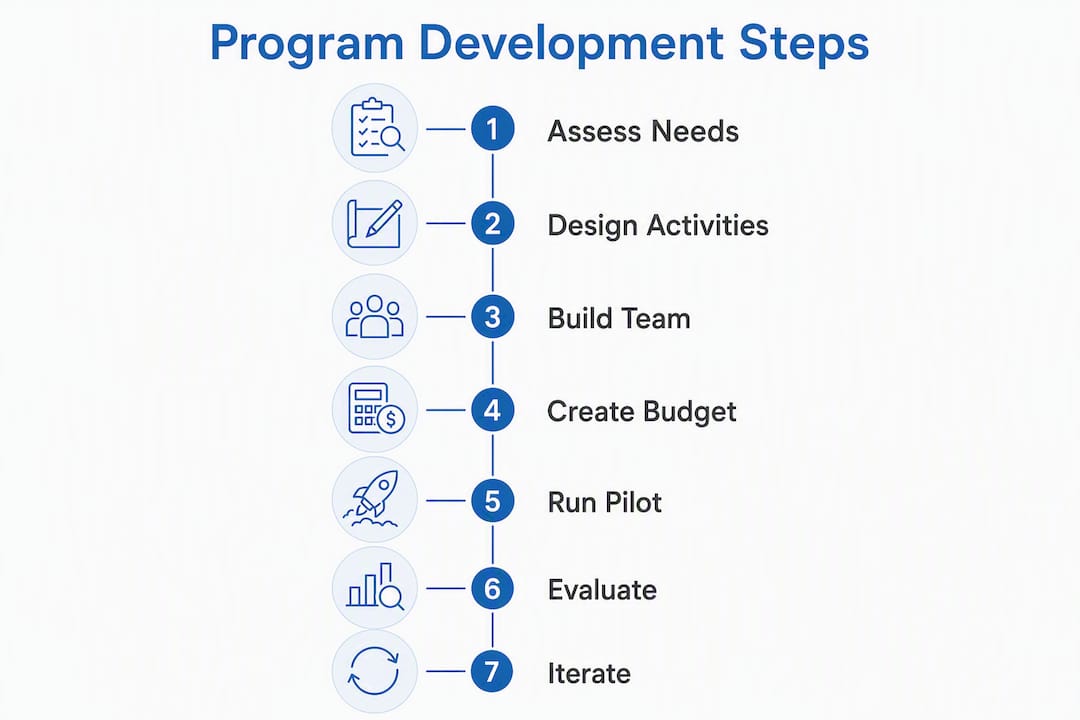
Effective nonprofit program planning follows a clear sequence. Here is a practical version you can assign to your team, with ownership and minimum outputs at each step.

1. Identify and document the need (Weeks 1–4, owned by Executive Director and Program Director) Minimum output: a two-page needs assessment summary with community data, gap analysis, and stakeholder input. This document becomes the foundation of your case for support.
2. Define outcomes and build a logic model (Weeks 3–6, owned by Program Director and M&E Lead) Choose 1–3 primary outcomes before designing a single activity. Then map your logic model:
- Inputs: staff time, funding, partner resources, facilities
- Activities: workshops, case management sessions, training cohorts
- Outputs: number of participants served, sessions delivered, materials distributed
- Outcomes: knowledge gained, behavior changed, economic status improved
- Impact: long-term community-level change
3. Design activities and the delivery model (Weeks 5–8, owned by Program Director) Minimum output: a written program plan that covers service delivery methods, frequency, target population, eligibility criteria, and referral pathways. Treating this plan like a mini business plan strengthens grant writing later: include a market analysis of existing services, a staffing plan, a timeline, and a basic risk analysis.
4. Build the staffing and governance plan (Weeks 6–9, owned by Executive Director and Board Chair) Minimum output: an org chart for the program, role descriptions, and a board resolution or formal approval. Identify whether you need new hires, volunteers, or contracted specialists.
5. Develop the budget and sustainability plan (Weeks 7–10, owned by Finance Director and Executive Director) Minimum output: a line-item program budget with one-time and recurring costs separated, plus a one-page sustainability narrative. See Section 5 for budget components.
6. Design and run a pilot (Months 3–6, owned by Program Director) Minimum output: a pilot plan with scope, timeline, sample size or service volume target, and a go/no-go decision framework. See Section 6 for the full pilot checklist.
7. Monitor, evaluate, and iterate (Ongoing from Month 1, owned by M&E Lead) Minimum output: an M&E plan with indicators, data collection tools, reporting schedule, and a learning review calendar.
Setting milestone timelines in ranges rather than fixed dates keeps plans adaptable without losing structure. "Weeks 5–8" is more realistic than "June 15" when staff capacity fluctuates or a funder review takes longer than expected.
The Program DPro framework from PM4NGOs adds five principles that should run through every step: well-governed, participatory, comprehensive, integrated, and adaptive. The adaptive principle is the one most teams underweight. Build explicit review points into your calendar from day one, not just at year-end.
How do you design outcomes and indicators you can actually measure?
Define your 1–3 primary outcomes before you design a single activity. This sounds obvious, but most programs get it backwards: they design activities first, then scramble to find metrics that justify them. That sequence produces outputs masquerading as outcomes.
For each primary outcome, choose 2–4 indicators. One outcome indicator and one process indicator is often sufficient for a small program with limited data capacity.
Example indicator structure:
- Indicator: Percentage of participants who report increased financial literacy skills
- Unit of measure: Percent
- Data source: Pre/post participant survey
- Collection frequency: At program entry and program exit
- Responsible role: Program Coordinator
Small-data collection methods that work without a research team:
- Short pre/post surveys (5–10 questions, paper or Google Forms)
- Client intake forms that capture baseline demographics and presenting needs
- Simple service logs tracking attendance, session topics, and referrals made
- Qualitative case notes from staff after each session or client interaction
- Quarterly focus groups with a small sample of participants
Bring in an external evaluator when you are preparing for a major funder, scaling to a new geography, or when your team has a conflict of interest in reporting results. For most pilots and first-year programs, internal data collection with a clear protocol is sufficient.
Programs that embed regular review points and adaptation steps produce better long-term outcomes than those that only evaluate at the end. Annual evaluation is a baseline standard, but small nonprofits should scope their evaluation to the most critical program questions rather than trying to measure everything.
Pro Tip: Dedicate 15 minutes of every monthly staff meeting to reviewing one indicator. Ask: "What does this number tell us, and what would we change?" That habit turns M&E from a reporting obligation into an actual learning tool.
How do you build a program budget and make the case for funding?
Build your budget by linking every line item to a specific program activity. A budget that cannot be traced back to what you actually do is a red flag for funders and a planning failure for your team.

Core budget components:
| Category | Examples | Notes |
|---|---|---|
| Personnel | Program staff salaries, coordinator time | Allocate by % of FTE dedicated to the program |
| Fringe benefits | Health insurance, payroll taxes | Typically 20% of personnel costs |
| Program supplies | Curriculum materials, client kits | Separate one-time from recurring |
| Travel | Staff mileage, client transportation | Document reimbursement rates |
| Evaluation | Survey tools, data analysis, external evaluator | Often underfunded; budget at least 5–10% of total |
| Overhead/indirect | Rent, utilities, admin support | Use a documented indirect cost rate |
| One-time startup | Equipment, training, software setup | Flag clearly as non-recurring |
A sustainability narrative does not need to be long. One page that answers three questions is enough: What revenue sources will fund this program beyond the first grant? What is the realistic timeline to diversify funding? What would the program look like at reduced funding, and what is the minimum viable version?
A short case for support outline:
- Problem statement: What is the documented need, and who is affected?
- Evidence of need: Data from your needs assessment, local statistics, community voice
- Proposed solution and outcomes: What you will do, for whom, and what will change
- Budget snapshot: Total cost, funding secured, funding gap
- Sustainability plan: Revenue diversification strategy and timeline
- Call to action: Specific ask with a dollar amount or partnership request
During a pilot, test at least two fundraising tactics: individual donor cultivation and a grant application to a local foundation. Funders frequently encourage or require collaboration, so documented partner roles in your budget narrative can strengthen a grant application considerably.
One common funding pitfall: securing a short-term pilot grant without a plan for what happens when it ends. Build your sustainability narrative into the program design from the start, not as an afterthought in year two.
How do you design and run a credible pilot?
A pilot answers specific questions about whether your program works as designed. Keep the scope narrow enough to generate clean learning, but large enough to produce meaningful data.
Pilot design essentials:
- Define 2–3 questions the pilot must answer (e.g., "Can we recruit and retain the target population?" or "Does the curriculum produce the intended knowledge gains?")
- Set a realistic service volume target (e.g., 20–40 participants over 12 weeks)
- Choose a timeline in a range: 8–16 weeks is typical for a first pilot
- Identify your go/no-go criteria before you launch, not after
Implementation checklist:
- Staff training completed and documented
- Standard Operating Procedures written for intake, service delivery, and data collection
- Data collection forms tested with at least two staff members before launch
- Intake workflow mapped and communicated to referral partners
- Partnership MOUs signed with any collaborating organizations
- Basic risk controls in place (data privacy, incident reporting, grievance process)
- Participant consent forms reviewed by legal counsel or a board member with relevant expertise
What to monitor and when:
- Weekly: Attendance, referral volume, staff capacity flags, any participant safety concerns
- Monthly: Indicator data against targets, budget actuals vs. projections, staff feedback on delivery challenges
Capture beneficiary feedback early. A short 3–5 question check-in at the midpoint of the pilot often surfaces delivery problems you would not catch in the data alone.
Success criteria and next-step triggers:
- Scale: Pilot met or exceeded service volume targets, indicators trending positive, funding secured for expansion
- Iterate: Indicators mixed, delivery model needs adjustment, participant feedback points to specific gaps
- Close: Fundamental design flaw confirmed, population cannot be reached as planned, or funding is not viable
When is a program actually ready to scale?
Scale only after four conditions are met: a proven pilot with documented outcomes, a repeatable delivery model, a stable funding plan covering at least 6–12 months of operations, and written SOPs that a new staff member could follow without direct supervision.
Readiness checklist before scaling:
- Pilot outcomes data reviewed and documented
- Delivery model tested with at least one staff transition (can someone new run it?)
- Funding runway confirmed for the expansion period
- Partner network capacity assessed and agreements updated
- Data systems able to handle increased volume
- Board formally briefed and supportive of the expansion plan
Common scaling paths and trade-offs:
| Path | Description | Best for | Key risk |
|---|---|---|---|
| Deepen locally | Serve more people in the same geography | Programs with unmet local demand | Capacity strain on existing staff |
| Replicate with partners | Train partner agencies to deliver the model | Programs with a transferable curriculum | Quality drift without strong SOPs |
| Franchise/light-touch | Provide tools and standards; partners self-implement | Widely applicable models | Fidelity to the model is hard to monitor |
| Policy/advocacy scale | Influence systems so the model becomes standard practice | Programs with strong evidence base | Long timeline, requires different skills |
SOPs are the operational foundation for scaling. Codify intake, service delivery, quality checks, and reporting in simple step-by-step documents before you bring on new staff or partner agencies. Without them, quality drift is almost inevitable as you grow.
Risk mitigation during expansion:
- Use phased rollouts: add one new site or cohort at a time
- Maintain a monthly quality assurance review against your SOPs
- Keep at least one experienced staff member in a supervisory or training role during the first expansion cycle
- Watch for early warning signs: rising staff turnover, declining participant retention, budget overruns in the first quarter of expansion
What mistakes derail nonprofit programs most often?
The most common failures are launching without community data, letting funding opportunities drive program design, building delivery systems too thin to sustain quality, and under-budgeting for evaluation.
Red flags to watch for:
- No documented needs assessment: If you cannot point to data that confirms the problem exists and is underserved, you are building on assumption.
- Inconsistent service delivery: Participants receive different experiences depending on which staff member serves them. This is almost always a sign that SOPs do not exist or are not being followed.
- Mismatched staffing skills: Hiring for enthusiasm rather than competency in the specific service area. A workforce development program run by staff with no employment services background will struggle regardless of how good the curriculum is.
- Evaluation as an afterthought: Budgeting zero for data collection, then scrambling to produce impact data when a funder asks for it.
- Scope creep during the pilot: Adding services or populations mid-pilot because a partner asks or a funder suggests it. This contaminates your learning and makes it impossible to know what worked.
Use your first-year data as an early warning system. If attendance is declining in month two, do not wait until the annual review to investigate. If your budget actuals are running 20% over projections in the first quarter, that is a signal to revisit your cost assumptions now, not at year-end.
What templates and tools do you actually need?
You do not need expensive software to execute a solid program development process. You need the right documents and a few well-chosen tools.
Must-have templates:
- Needs assessment survey (10–15 questions, mix of quantitative and open-ended)
- Logic model template (inputs, activities, outputs, outcomes, impact)
- Program plan outline (population, activities, staffing, timeline, budget summary)
- Line-item budget spreadsheet with one-time vs. recurring cost separation
- Pilot plan (scope, questions, timeline, service volume target, go/no-go criteria)
- M&E tracker (indicators, targets, data source, collection frequency, responsible role)
- SOP checklist template (intake, service delivery, data collection, reporting)
Tool categories by function:
- Project management: Asana, Trello, or Monday.com work well for small teams tracking program tasks and milestones. Pick one and use it consistently.
- Data collection: Google Forms or SurveyMonkey for surveys; Airtable for service logs and case tracking if you need something more structured than a spreadsheet.
- Donor CRM and fundraising: Bloomerang, Little Green Light, or Salesforce Nonprofit Success Pack, depending on your budget and volume.
- Shared documents: Google Workspace or Microsoft 365 for collaborative editing of program plans, SOPs, and reports.
For training, Leaderosity's program design courses cover needs assessment, defining outcomes, and measurement in a structured format. The CSDi Design, Fund and Manage Nonprofit Programs Certificate is worth considering for staff who will own program development long-term. Invest in external training when a staff member is taking on a program director role for the first time or when your team is preparing to scale.
Pro Tip: Before buying any software, map your actual data workflow on paper. Most small nonprofits discover they need a better spreadsheet discipline, not a new platform. Buy the tool after the process is clear, not before.
How Nonprofitconsultingswfl supports program development in practice
A Florida-based environmental education nonprofit came to Nonprofitconsultingswfl with a program idea and no clear path from concept to funder-ready plan. The organization had community relationships and passion, but no documented needs assessment, no logic model, and no budget tied to specific activities.
The engagement covered:
- A structured needs assessment process, including stakeholder interviews and a review of local service gap data
- Logic model development with the program team, resulting in three primary outcomes with measurable indicators
- A pilot plan with a defined scope, service volume targets, and a go/no-go framework
- A line-item program budget with a sustainability narrative built for grant submission
- SOP drafts for intake and service delivery, ready for staff training
The result was a grant-ready program package that the organization could present to funders with confidence. The program launched its pilot within six months of the initial engagement.
Nonprofitconsultingswfl's services span the full development timeline: strategic planning, grant writing assistance, capacity building, M&E setup, and SOP development. Engagements are structured to deliver tangible outputs, not just recommendations.
- Strategic planning: Aligning program design with organizational mission and multi-year goals
- Grant writing assistance: Building cases for support grounded in needs assessment data and outcome evidence
- Capacity building: Training staff on program management, data collection, and reporting
- M&E setup: Designing indicator frameworks and data collection systems that fit small-team capacity
Key Takeaways
Effective program development for nonprofits requires a documented needs assessment, a logic model with measurable outcomes, a pilot with clear go/no-go criteria, and a sustainability plan before any serious scaling begins.
| Point | Details |
|---|---|
| Start with community data | A needs assessment confirms the problem is real and underserved before you commit resources. |
| Define outcomes before activities | Choose 1–3 primary outcomes first; then design activities that produce them, not the reverse. |
| Pilot with clear criteria | Set go/no-go criteria before launch so the pilot produces usable decisions, not just activity data. |
| Budget for evaluation | Allocate at least 5–10% of total program budget to evaluation; underfunding it is a common funder red flag. |
| Nonprofitconsultingswfl | Provides end-to-end program development support for Florida nonprofits, from needs assessment through grant-ready documentation and pilot design. |
What nonprofit leaders consistently underestimate about program development
Most program development advice focuses on the documents: the logic model, the budget, the case for support. Those matter. But the thing that actually determines whether a program survives its first two years is whether the delivery system is repeatable without the person who designed it.
That is the gap most leaders do not see until it is expensive. A program director leaves, a key volunteer moves on, a partner organization changes priorities. If the program exists primarily in someone's head rather than in documented SOPs, intake workflows, and a trained team, it does not survive the transition. The documentation is not bureaucracy. It is the program.
The second underestimated factor is the relationship between M&E and adaptation. Most organizations treat evaluation as a reporting requirement: collect data, write a report, send it to the funder. The organizations that actually improve their programs use the same data to make decisions monthly. They ask "what does this tell us about what to change?" not "what does this tell us to report?" That shift in framing is the difference between a program that gets better and one that just gets older.
The prioritization framework that holds up under resource pressure: prove one core outcome before adding a second. Secure at least 6–12 months of committed funding before scaling. Partner strategically, because documented partner roles strengthen both your delivery capacity and your funder appeal. And write the SOPs before you need them, not after the first quality problem surfaces.
Nonprofitconsultingswfl: practical support for every stage of program development
Building a program from idea to funded, operational reality is a multi-month process with a lot of moving parts. Nonprofitconsultingswfl gives Florida nonprofits a structured path through it, without the cost of a full-time internal consultant.
The consulting model is built around deliverables, not just advice. A typical engagement produces a completed needs assessment, a logic model, a pilot plan, a line-item budget with sustainability narrative, and a grant-ready case for support. For organizations preparing to scale, the scope expands to include SOP development, M&E system setup, and staff training. Engagements generally run 6–12 weeks for initial program development support, with options for ongoing grant writing and capacity building.
If your organization is at any stage of the program development process, from early idea to mid-pilot, book a scoping call with Nonprofitconsultingswfl to clarify your priorities and get a clear picture of what support would look like for your specific situation.
Useful sources and further reading
These sources back the guidance in this article and are worth bookmarking for ongoing program planning work.
- Program DPro Guide (PM4NGOs) — The most thorough framework for program lifecycle management available to nonprofit practitioners. Use it for M&E design, adaptive management principles, and governance structure.
- Nonprofit Program Development Process | Capterra — Practical five-step overview with useful guidance on milestone timelines and the 88% program-change statistic. Good starting point for teams new to formal program planning.
- Mission-driven strategies for effective nonprofit program development | Candid — Covers partnership strategy and sustainability planning with a funder perspective. Particularly useful when building your case for support.
- Overview of Non-Profit Program Planning | Kent State Literacy and OASIS — Concise guidance on annual evaluation standards and scoping evaluations for small nonprofits with limited resources.
- Basic Guide to Nonprofit Program Design and Marketing — Carter McNamara's foundational guide covering program structure, marketing, and evaluation basics. A useful reference for organizations building their first formal program.
- U.S. Census Bureau — Primary source for community demographic data to support needs assessments. Use American Community Survey data for local population and economic indicators.