

TL;DR:
- Peer-to-peer fundraising involves supporters creating personal pages to solicit donations within their networks, increasing reach through trust. It outperforms traditional crowdfunding by decentralizing asks and leveraging social proof, leading to higher engagement. Successful campaigns require strategic planning, platform selection, motivated fundraisers, compelling pages, and ongoing stewardship.
Peer-to-peer fundraising is a campaign model where your supporters create personal fundraising pages and solicit gifts from their own networks on your behalf. It works best when you have an engaged base of volunteers, board members, or recurring donors willing to make a personal ask, and when your team has the capacity to onboard and support them. If that describes your organization, the single most useful first step is to draft a short recruitment list of 10–20 people you'd ask to fundraise for you, then evaluate which platform can host their pages and connect to your CRM without a manual reconciliation nightmare.
Table of Contents
- What is peer-to-peer fundraising, and how does it differ from crowdfunding?
- What types of P2P campaigns should you consider?
- Why does peer-to-peer fundraising benefit nonprofits?
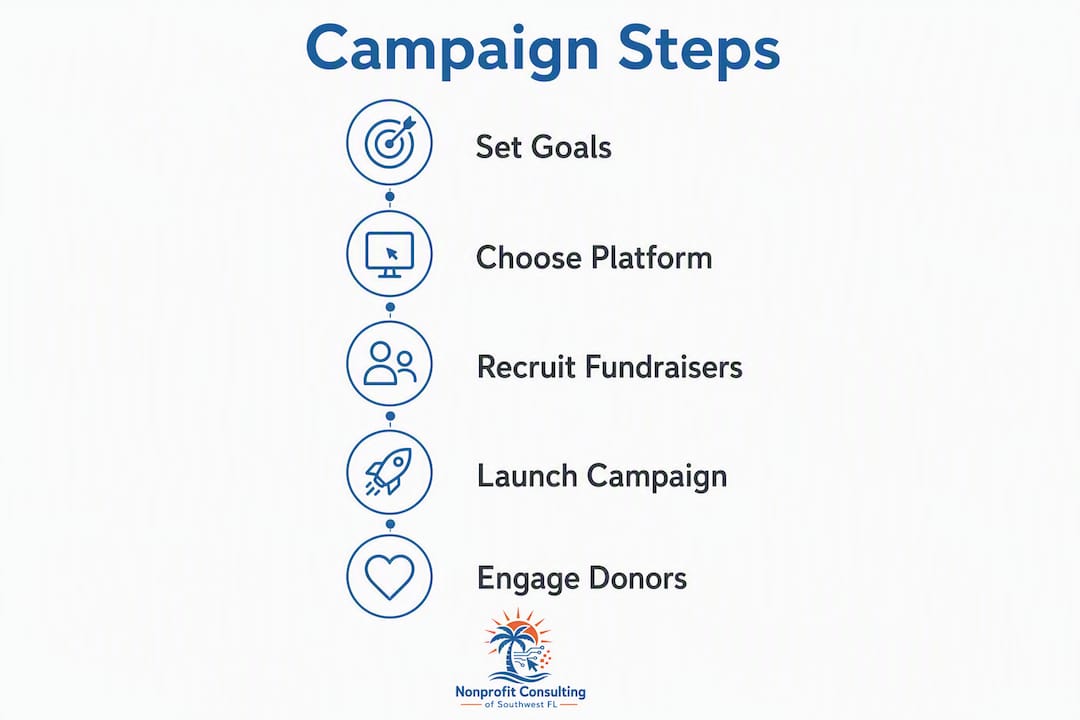
- How do you plan and launch a peer-to-peer campaign step by step?
- How do you choose the right P2P platform?
- How do you recruit, onboard, and motivate volunteer fundraisers?
- How do you design fundraiser pages that actually convert?
- What KPIs and metrics should you track?
- What fees, legal issues, and common pitfalls should you watch for?
- What are the best campaign ideas and templates to get started?
- Research-backed tactics for stewardship and segmentation
- Key Takeaways
- What most guides get wrong about peer-to-peer fundraising
- Nonprofitconsultingswfl can help you launch your next P2P campaign
- Useful sources and further reading
- FAQ
What is peer-to-peer fundraising, and how does it differ from crowdfunding?
In a traditional crowdfunding campaign, your organization runs one shared page and drives traffic to it. Peer-to-peer fundraising (often called P2P or social fundraising) flips that model: individual supporters each create their own personalized page, tell their own story, and ask their personal networks to give. The funds still flow to your nonprofit, but the ask comes from a friend, a colleague, or a family member rather than from your organization directly. That distinction matters because personalized appeals from people donors already trust convert at higher rates than appeals from organizations they may barely know.
A few concrete examples show the range of what P2P looks like in practice:
- A runner in your annual 5K creates a page, sets a $500 goal, and emails 30 friends.
- A board member runs a birthday fundraiser asking her LinkedIn network to give instead of sending gifts.
- A virtual fitness challenge lets participants log miles and collect pledges from coworkers.
- A giving day activates dozens of fundraiser pages simultaneously for a 24-hour push.
The structural difference from crowdfunding is decentralization. Crowdfunding concentrates attention on one page; P2P distributes the ask across many personal pages. That means more touchpoints, more social proof, and more potential donors who would never have found your organization on their own.
The sector numbers reflect that reach. The top 30 peer-to-peer fundraising programs grew 3.2% in 2023 and together raised $1.1 billion, a 15.6% increase over 2022. That growth signals a model that is gaining traction, not plateauing.
What types of P2P campaigns should you consider?
Not every campaign format fits every organization. The right choice depends on your timeline, your fundraiser pool, and how much staff time you can commit.

Rolling (ongoing) campaigns stay open year-round and let supporters launch a page whenever the moment is right, such as a birthday, a personal milestone, or a local event. They require minimal launch effort but need a steady stream of recruitment and a clear page template so new fundraisers don't start from scratch.
Event-driven P2P ties fundraising pages to a physical or virtual event: a 5K, a gala, a golf tournament. Participants register, get a page, and fundraise before the event date. The event itself becomes the deadline that drives urgency. This format pairs well with charity event planning because the logistics and the fundraising calendar align naturally.
Giving days concentrate everything into 24 hours. GivingTuesday is the most recognized example in the U.S., but many organizations run their own local giving days. The urgency is real, but so is the preparation requirement: giving days need heavy pre-promotion and technical readiness well before launch day.
Virtual challenges work especially well for health-focused or community-based nonprofits. The ALS Ice Bucket Challenge is the most famous example, but smaller organizations run readathons, step challenges, and cooking contests with the same mechanics. Participants collect pledges, post on social media, and tag friends to join.
Team pages add a layer on top of individual pages. Participants join a team (a company, a school, a neighborhood), compete against other teams, and the leaderboard drives friendly competition. This format suits corporate partnership programs and school fundraisers.
A quick decision guide: if you have a physical event already on the calendar, event-driven P2P is the lowest-lift entry point. If you want year-round donor acquisition, a rolling campaign makes more sense. If you want a concentrated burst of online giving campaigns with high social media visibility, a giving day or virtual challenge delivers that, at the cost of more upfront planning.
Why does peer-to-peer fundraising benefit nonprofits?
The clearest benefit is new donor acquisition at a lower cost than most traditional channels. When a fundraiser asks 30 people in her network, a significant portion of those donors have never given to your organization before. You didn't spend anything to reach them; she did the outreach. That dynamic shifts your acquisition cost dramatically compared to direct mail or paid digital advertising.

Beyond acquisition, P2P deepens engagement in ways that a standard donation form cannot. Fundraisers become invested stakeholders, not passive supporters. They've put their name and reputation behind your cause. That personal commitment tends to translate into longer-term loyalty, both for the fundraiser and for the donors they bring in.
Key benefits worth building into your case for internal approval:
- Expanded reach: Each fundraiser extends your message to a network you couldn't otherwise access.
- Social proof at scale: Dozens of personal stories circulating on social media carry more credibility than a single organizational post.
- Lower donor acquisition cost: Supporters absorb the outreach effort; your cost is primarily platform and staff time.
- Stewardship opportunity: The campaign creates natural touchpoints to thank, recognize, and deepen relationships with your most engaged supporters.
- Brand amplification: Fundraisers sharing your mission on their own channels builds awareness that outlasts the campaign itself.
The stewardship angle is underused. Most organizations treat P2P as a revenue event and miss the chance to convert their top fundraisers into board prospects, major gift donors, or long-term volunteers. Treating the campaign as a high-touch stewardship event and involving board members in personal thank-you efforts raises volunteer satisfaction and retention in ways that a generic mass email never will.
How do you plan and launch a peer-to-peer campaign step by step?
A well-run P2P campaign follows a clear sequence. Skipping steps, especially in the first four weeks, is the most common reason campaigns underperform.
Campaign planning checklist
Before you open a platform account or send a single recruitment email, lock in these decisions:
- Set a specific dollar goal and a fundraiser count goal. "Raise $50,000 with 50 fundraisers" is a plan. "Raise as much as possible" is not.
- Define your audience. Who are you recruiting as fundraisers? Who are their likely donors?
- Set a timeline. Eight to twelve weeks from kickoff to close is standard for a first campaign.
- Assign roles. Name one person responsible for recruitment, one for CRM updates, and one for communications.
- Estimate your budget. Include platform fees, payment processing, any paid promotion, and staff time.
Sample 8–10 week timeline
- Weeks 1–2: Finalize platform, configure pages, build your fundraiser recruitment list, draft your toolkit.
- Weeks 3–4: Send recruitment emails, host a kickoff call, onboard early fundraisers, set up CRM integration.
- Week 5: Launch publicly. Send a launch-day email to your full list. Post on all social channels.
- Weeks 6–7: Weekly check-ins with fundraisers. Send mid-campaign updates. Activate leaderboards.
- Week 8: Final push. Send urgency emails. Activate board members for personal outreach.
- Post-campaign (weeks 9–10): Thank all fundraisers and donors. Reconcile CRM records. Pull KPI report.
Communications calendar outline
A multi-channel outreach plan that combines email, social media, and direct personal contact outperforms campaigns that rely solely on fundraisers' own networks. Plan for:
- Three to four fundraiser-facing emails (recruitment, onboarding, mid-campaign check-in, final push)
- Two to three donor-facing emails from your organization (launch announcement, mid-campaign story, close)
- Weekly social posts from your organization's accounts
- A personal phone call or text from a staff member or board member to your top 10 fundraisers at the midpoint
Pro Tip: Prepare a launch-day checklist the week before you go live: confirm platform is configured, test a mock donation, verify CRM mapping, and send a "you're live" email to all fundraisers the morning of launch.
Templates to prepare before launch
- Recruitment email (subject line, two-paragraph body, clear ask)
- Fundraiser onboarding guide (one page: how to set up your page, your story template, three social posts)
- Social copy in three lengths (tweet-length, short post, long-form email)
- Thank-you scripts for fundraisers and for donors
- Mid-campaign check-in email for fundraisers who haven't yet made their first ask
How do you choose the right P2P platform?
Platform selection is where many nonprofits lose weeks of time and thousands of dollars in avoidable fees. The right platform for your organization depends on three factors: feature fit, fee structure, and CRM compatibility.
Essential features to evaluate
- Individual fundraiser pages with editable story fields and photo/video upload
- Goal thermometer and progress display visible to donors
- Team page functionality (if you plan team-based campaigns)
- Built-in communication tools (email to fundraisers from the platform)
- Mobile-optimized donation flow
- Reporting exports (CSV or direct API)
- Donor receipt automation
Fee structures and how to calculate net proceeds
Platform fees and payment processing fees are separate charges, and both reduce what your organization actually keeps. A worked example makes this concrete:
Suppose your campaign raises $10,000 gross. A typical platform fee might be 3–5% of funds raised, and payment processing (usually Stripe or a similar processor) adds roughly 2.2% plus $0.30 per transaction. On $10,000 with an average gift of $50 (200 transactions):
- Platform fee at 4%: $400
- Payment processing at 2.2% + $0.30 per transaction: $220 + $60 = $280
- Estimated refunds (1–2%): $100–$200
- Net proceeds: approximately $9,120–$9,220
Some platforms charge a flat monthly subscription instead of a percentage, which can be more cost-effective for high-volume campaigns. Always model both scenarios before signing up.
Pro Tip: Before committing to any platform, run one internal test: create a mock fundraiser page, make a small test donation by credit card, export the donation data, and verify that the donor record maps correctly to your CRM. This single test surfaces integration gaps before they become a reconciliation problem.
Vendor evaluation scorecard
| Evaluation Criterion | Why It Matters | What to Look For |
|---|---|---|
| CRM integration | Prevents manual reconciliation | Native connector or Zapier support for your CRM |
| Fee transparency | Protects net proceeds | Published fee schedule; no hidden per-fundraiser charges |
| Page customization | Supports brand consistency | Lock brand elements; allow personal story edits |
| Reporting depth | Enables KPI tracking | Fundraiser-level and donor-level export |
| Mobile experience | Donors give on phones | Test the donation flow on a mobile device |
| Support quality | Reduces launch risk | Live chat or phone support during campaign hours |
Poor CRM integration is one of the most common operational failures in P2P campaigns, forcing weeks of manual reconciliation after the campaign closes. Treat CRM compatibility as a non-negotiable criterion, not a nice-to-have.
How do you recruit, onboard, and motivate volunteer fundraisers?
Your fundraiser pool is the engine of the campaign. A well-designed platform with weak fundraisers will underperform a simple setup with 20 highly motivated people who actually make the ask.
Who to recruit first
Start with people who already have a demonstrated relationship with your organization and a personal network likely to give:
- Board members (they have credibility and a professional network)
- Major donors who have expressed enthusiasm for your mission
- Committed long-term volunteers
- Recurring donors, especially those who have attended events
- Staff members willing to participate personally
Aim for 10–15 confirmed fundraisers before you launch publicly. A campaign that opens with active pages already showing progress creates social proof for later recruits.
Onboarding checklist
- Send a personal recruitment email or make a personal call (not a mass blast).
- Host a 30-minute orientation call: explain the campaign goal, show them how to set up their page, and walk through the toolkit.
- Provide a pre-written story template they can personalize in under 10 minutes.
- Give them three ready-to-post social messages in different lengths.
- Assign a staff contact they can reach with questions.
Providing fundraisers with a storytelling template and pre-drafted social copy removes the friction of asking and gets them to their first outreach faster. The organizations that skip this step see fundraisers who set up a page and then go silent.
Motivation and recognition
Gamification elements like thermometers, leaderboards, and badges are effective at motivating fundraisers when combined with personal stewardship. A leaderboard alone can feel competitive in an uncomfortable way; pair it with a personal check-in call from a staff member or board member and it becomes energizing.
Recognition ideas that work:
- Weekly "top fundraiser" shoutout in your campaign email
- A personal thank-you call from the executive director when a fundraiser crosses their goal
- A small recognition gift (handwritten note, branded item) mailed after the campaign
- An invitation to a post-campaign celebration or debrief event
Pro Tip: Identify your top three fundraisers by week two and assign a board member to each one for a personal check-in. Those three people are your best candidates for deeper engagement after the campaign ends.
How do you design fundraiser pages that actually convert?
The page design conversation usually gets stuck on colors and logos. The real conversion drivers are simpler: a personal story, a specific goal, visible progress, and a clear donate button that works on a phone.
What to lock vs. what to let fundraisers edit
Lock your organization's logo, the campaign name, the donation destination, and the legal language. Let fundraisers edit their headline, their personal story, their photo or video, and their individual goal. That balance protects brand consistency while giving fundraisers enough ownership to feel personally invested in their page.
Page wireframe
A high-converting fundraiser page typically includes:
- Headline: — Fundraiser's name + a one-line personal connection to the cause ("I'm running for my dad, who was diagnosed with ALS in 2022.")
Sample donor ask copy
Here are three templates fundraisers can copy directly:
Tweet/short post (under 280 characters): "I'm raising money for [Organization]. Every dollar goes toward [specific program]. Can you help me reach my goal? [link]"
Short social post: "This cause means a lot to me personally. I'm fundraising for [Organization] because [one-sentence personal reason]. My goal is $[amount] by [date]. Even $25 makes a real difference. [link]"
Email ask: "Hi [Name], I'm reaching out because I'm fundraising for [Organization] this [month/season]. [Two sentences about why you care.] I'm trying to raise $[amount] by [date], and I'd be grateful if you'd consider a gift of any size. Here's my page: [link]. Thank you."
Pro Tip: Tell fundraisers to send the email version to their 10 closest contacts before posting publicly on social media. Personal emails convert at a much higher rate than social posts, and starting with a few donations makes the page look active before the broader audience sees it.
Visual and accessibility basics: use a real photo (not a stock image), keep the page load time under three seconds, write alt text for images, and test the full donation flow on both iOS and Android before launch.
What KPIs and metrics should you track?
Tracking the right numbers tells you whether the campaign is on track and gives you the data to improve the next one. Here are the core KPIs, their formulas, and what they tell you.
Core KPIs and formulas
Les principaux indicateurs à suivre comprennent : total collecté, valeur moyenne du don, nombre de collecteurs actifs, taux d’activation des collecteurs, taux d’acquisition de nouveaux donateurs, montant moyen collecté par collecteur et taux de conversion (visites de pages/donations). Cela permet d’évaluer la santé générale de la campagne, l’efficacité du recrutement, la portée au-delà de la base existante, et la qualité de l’expérience utilisateur.
Benchmarks and reporting cadence
A healthy fundraiser activation rate is typically above 60% for a well-onboarded cohort. Average raised per fundraiser varies widely by campaign type, but tracking it week over week tells you whether your mid-campaign support is working.
Run a weekly status report during the campaign covering: total raised to date vs. goal, active fundraiser count, top five fundraisers, and any technical issues. After the campaign closes, produce a full post-campaign report that includes donor acquisition numbers, cost per dollar raised, and a fundraiser retention rate (how many said yes to participating again).
Key metrics to include in your post-campaign stakeholder report:
- Total raised and percentage of goal achieved
- Number of unique donors and percentage who were new to your database
- Number of fundraisers recruited vs. activated
- Average gift size and average raised per fundraiser
- Platform and processing fees as a percentage of gross revenue
- Net proceeds retained
What fees, legal issues, and common pitfalls should you watch for?
Fee math and financial reconciliation
The worked example in the platform selection section above shows how platform fees, payment processing, and refunds layer together. Build that calculation into your campaign budget before you set your public goal, not after. If your platform charges 4% and processing adds another 2.5%, you need to raise roughly $106.50 to net $100. Set your goal based on net proceeds, not gross.
For financial reconciliation, reconcile donation records between your platform and your CRM within 48 hours of campaign close. Waiting longer makes it harder to match split gifts, refunds, and matching gift transactions.
Donor privacy and data handling
- Confirm that your platform's privacy policy is compatible with your organization's data-handling commitments.
- Verify that donor records created in the P2P platform automatically append or update CRM profiles rather than creating duplicate records.
- Ensure automated tax receipts go out within 24 hours of each gift.
- Clarify data ownership in your platform contract: you should own all donor data, not the platform.
Permits and sales-tax considerations
In the U.S., fundraising registration requirements vary by state. If your campaign involves merchandise sales (T-shirts, branded items), you may be subject to sales tax collection obligations in states where you have nexus. If your event includes raffles or games of chance, state-specific gaming permits may apply. Consult your organization's legal counsel or a nonprofit compliance specialist before adding merchandise or raffle components to a P2P campaign.
Pro Tip: Check your state's charitable solicitation registration status before launching a P2P campaign that will reach donors in multiple states. Many states require registration before you solicit residents, even online. The National Association of State Charity Officials (NASCO) maintains a state-by-state guide.
Common operational pitfalls
- Weak CRM integration: Donor records don't sync, creating weeks of manual cleanup. Test integration before launch.
- Unclear donor attribution: When a fundraiser's page generates a gift, make sure your CRM records both the fundraiser and the donor correctly.
- No mid-campaign support: Fundraisers who don't hear from you after onboarding go quiet. Build in at least two touchpoints during the campaign.
- Underestimating refund rates: Budget for 1–3% of gross in refunds, especially for events where participants may cancel.
This guide provides general information, not legal or financial advice. Confirm current registration requirements, tax obligations, and compliance rules with a qualified attorney or CPA familiar with nonprofit law in your state.
What are the best campaign ideas and templates to get started?
Campaign ideas by category
Event-based:
- Annual 5K or fun run with individual fundraiser pages per participant
- Gala with a pre-event fundraising leaderboard among table captains
- Golf tournament where each foursome has a team fundraising page
Challenge-based:
- Virtual fitness challenge (steps, miles, minutes of activity logged over 30 days)
- Readathon where participants collect pledges per book or chapter completed
- Cooking or baking challenge with social media sharing built in
Occasion-based:
- Birthday fundraisers (supporters ask for donations instead of gifts)
- Work anniversaries or retirement celebrations
- Memorial fundraisers honoring a loved one
Merchandise and product:
- Branded merchandise sales where a portion of proceeds goes to the campaign
- Cookbook or recipe collection fundraiser
- Custom artwork or photo prints sold through a campaign page
Ready-to-use templates
1. Recruitment email
Subject: Will you fundraise for us this [month]?
"Hi [Name], I'm reaching out personally because you've been one of our most dedicated supporters. This [month], we're launching a peer-to-peer fundraising campaign to [specific goal]. I'd love for you to create a personal fundraising page and share it with your network. It takes about 10 minutes to set up, and I'll send you everything you need. Can I count you in? Reply to this email or click here to get started: [link]."
2. Fundraiser starter story template
"I've been involved with [Organization] for [time period] because [one personal sentence]. This year, I'm fundraising to help them [specific program or goal]. My goal is $[amount] by [date]. If [Organization]'s work matters to you too, I'd be grateful for your support: [link]."
3. Social post sequence (three posts over two weeks)
- Post 1 (launch): "I just set up my fundraising page for [Organization]. Here's why I'm doing this: [link]"
- Post 2 (mid-campaign): "Halfway to my goal! Thank you to everyone who's donated. Still need [amount] more by [date]: [link]"
- Post 3 (final push): "Last 48 hours! Help me cross the finish line for [Organization]: [link]"
Research-backed tactics for stewardship and segmentation
The most durable lesson from donor engagement research is that donor engagement follows a continuous cycle of identification, cultivation, solicitation, and stewardship, and P2P campaigns should be mapped into that cycle rather than treated as a standalone event. The organizations that see the strongest retention treat the campaign itself as a stewardship moment, not just a revenue moment.
Segmentation by past gift size and engagement level turns generic appeals into higher-converting messages. A donor who gave $500 last year deserves a different message than someone who attended one event two years ago. Build at least three segments into your communications plan: lapsed donors, active mid-level donors, and major gift prospects.
90-day post-campaign stewardship cadence
| Timing | Action | Owner |
|---|---|---|
| Day 1–3 | Automated thank-you email to all donors | Platform/CRM |
| Day 7 | Personal thank-you call to top 10 fundraisers | Executive Director or Board Member |
| — | Impact update email to all donors (what their gifts will fund) | Communications staff |
| Day 30 | Personal note or call to top 20 donors | Major gifts staff |
| Day 60 | Invitation to volunteer role or next event | Volunteer coordinator |
| Day 90 | Soft cultivation ask or next campaign preview | Development staff |
Pro Tip: Build a 90-day stewardship plan for your fundraisers, not just your donors. Fundraisers who receive a personal thank-you call, an impact update, and an invitation to a volunteer role are far more likely to participate in your next campaign and to deepen their own giving.
Roles and resource checklist
Assign clear ownership before launch:
- Recruitment lead: Manages the fundraiser list, sends personal invitations, tracks responses.
- CRM manager: Configures integration, monitors sync, reconciles records post-campaign.
- Communications lead: Executes the email and social calendar, drafts templates.
- Stewardship lead: Manages thank-you calls, board outreach, and the 90-day cadence.
Key Takeaways
A successful peer-to-peer fundraising campaign requires a specific fundraiser goal, a CRM-integrated platform, a toolkit that removes friction for volunteers, and a 90-day stewardship plan that treats the campaign as a relationship-building event, not a one-time ask.
| Point | Details |
|---|---|
| Set dual goals | Define both a dollar target and a fundraiser count before launch; vague goals produce vague results. |
| Test CRM integration early | Run a mock donation and verify record mapping before the campaign goes live to avoid post-campaign reconciliation. |
| Equip fundraisers with copy | Provide a story template and three social posts; fundraisers with ready-made copy activate faster and raise more. |
| Track fundraiser activation rate | Aim for 60% or above; a low rate signals an onboarding or toolkit gap, not a recruitment problem. |
| Nonprofitconsultingswfl | Offers campaign planning, CRM integration support, and staff training for Florida nonprofits launching P2P campaigns. |
What most guides get wrong about peer-to-peer fundraising
The conventional wisdom on P2P fundraising focuses almost entirely on the platform: pick the right software, design a great page, and the donations will follow. That framing misses the actual bottleneck, which is almost always the fundraiser experience, not the donor experience.
The organizations that consistently outperform their goals are the ones that treat their volunteer fundraisers like major donors. They make personal calls before the campaign, not just mass emails. They check in at the midpoint with a real conversation, not an automated nudge. They send a handwritten note after the campaign closes. That level of attention takes more time than configuring a thermometer widget, but it's what separates a campaign that raises $8,000 from one that raises $40,000 with the same number of fundraisers.
There's also a persistent myth that P2P is a low-effort channel because the fundraisers do the work. The fundraisers do the outreach, but the nonprofit has to do the infrastructure work: CRM integration, toolkit preparation, mid-campaign support, and post-campaign stewardship. Organizations that understaff the campaign coordination role end up with fundraisers who feel abandoned and donors who never hear from the organization again.
For small nonprofits specifically, the temptation is to launch with whatever free platform is available and figure out the rest as you go. The CRM integration problem alone can cost a staff member two to three weeks of manual data entry after the campaign. That's a real cost that doesn't show up in the platform fee comparison. Getting the operational setup right before launch, even if it means delaying by two weeks, almost always produces a better outcome than launching fast and cleaning up afterward.
Nonprofitconsultingswfl can help you launch your next P2P campaign
Running a peer-to-peer campaign well means getting the strategy, the technology, and the stewardship right at the same time. For many Florida nonprofits, the gap isn't motivation; it's having someone who has done this before walk through the setup with you.
Nonprofitconsultingswfl works directly with nonprofit organizations across Florida on campaign planning, CRM integration, staff training, and capacity building. For a P2P campaign, that means helping you set realistic goals, evaluate platforms against your existing systems, build your fundraiser toolkit, and design a stewardship cadence that converts first-time campaign donors into long-term supporters. Tailored project scoping at the start of an engagement reduces launch risk and protects the donor relationships you've already built.
Book a consulting engagement with Nonprofitconsultingswfl to get a scoped plan for your next campaign before you open a platform account.
Useful sources and further reading
The sources below were used in building this guide. Each one is worth bookmarking for your own internal approvals or proposals.
- Peer-to-Peer Fundraising 101: Expert Tips for Your Campaigns (Kindful) — Sector benchmarks including the $1.1 billion collective revenue figure for the top 30 P2P programs.
- What Is Peer-to-Peer Fundraising? The Ultimate Guide (Bloomerang) — Covers platform mechanics, CRM integration pitfalls, and fundraiser toolkit best practices.
- Donor Engagement Strategies for Nonprofits (Fundraise Up) — Research-backed stewardship tactics including board involvement in thank-you outreach.
- Donor Engagement Ideas (Salesforce Nonprofit) — Segmentation guidance for personalizing P2P outreach by past gift size and engagement level.
- Peer-to-Peer Fundraising Guide: How to Launch a P2P Campaign (Bonterra) — Multi-channel marketing recommendations for supplementing fundraiser outreach.
- Donor Engagement Guide and Actionable Strategy Template (Kindsight) — Maps the donor engagement cycle (identification, cultivation, solicitation, stewardship) to P2P campaign planning.
- GivingTuesday — The primary resource for giving day planning, matching gift programs, and sector participation data.
- Alex's Lemonade Stand Foundation Campaigns — A real-world example of event-based and occasion-based P2P fundraising at scale.
- Funraise Peer-to-Peer Fundraising Features — Platform feature documentation useful for building your vendor evaluation scorecard.
- Nonprofitconsultingswfl — Consulting services for Florida nonprofits including P2P campaign planning, CRM integration, and capacity building.
FAQ
What is a real example of peer-to-peer fundraising?
The ALS Ice Bucket Challenge is the most widely recognized example: participants filmed themselves, posted on social media, and tagged friends to donate or participate. At the organizational level, the Susan G. Komen Foundation's More Than Pink Walk uses individual fundraiser pages tied to a physical event, which is a more typical model for most nonprofits.
How much does a platform like GoFundMe take from donations?
GoFundMe charges no platform fee for personal campaigns, but payment processing fees apply (typically around around 2.2% plus $0.30 per transaction for U.S. donations). For nonprofit campaigns specifically, fee structures vary by platform and plan; always model your net proceeds using the platform's published fee schedule before setting your public goal.
What is the roughly 80/20 rule in fundraising?
The roughly 80/20 rule in fundraising refers to the observation that roughly 80% of donations tend to come from about 20% of donors. In a P2P campaign, this means your top fundraisers and their closest contacts will likely drive the majority of your revenue, which is why identifying and personally stewarding your top 10–15 fundraisers is worth more than recruiting 50 passive participants.
What are the 3 C's of fundraising?
The 3 C's most commonly referenced in nonprofit fundraising are Cultivation, Communication, and Conversion: building the relationship before the ask, maintaining consistent outreach, and making a clear, specific request. In a P2P context, these map directly to your pre-campaign recruitment, your mid-campaign fundraiser support, and your page design and ask copy.
How do you keep donors engaged after a P2P campaign ends?
Send an impact update within two weeks of campaign close showing exactly what the funds will accomplish. Follow that with a personal outreach to your top donors at the 30-day mark, and an invitation to a volunteer role or your next event at 60 days. That 90-day cadence, described in the stewardship section above, is the difference between a one-time donor and a recurring supporter.