

Centralize your nonprofit's critical data and assign named data owners first. That single step, before any software purchase or policy document, is what unlocks faster funder reporting, cleaner donor records, and lower compliance risk. Three things you can do today:
- Identify every system where your organization stores data (spreadsheets, CRMs, case management tools, shared drives).
- Name a data steward for each major data category: program, fundraising, and finance.
- Run a one-day sample audit: pull 50 records from your most-used system and check for duplicates, missing fields, and inconsistent naming.
The Better Deal for Data (BD4D) framework and the CAN/DGSI 100-11:2025 standard both treat this kind of structured stewardship as the starting point for ethical, trust-based data governance. Nonprofitconsultingswfl works with Florida nonprofits to run exactly this kind of diagnostic before recommending any tools or workflows.
Pro Tip: Don't "centralize" by dumping every spreadsheet into one folder or a new database. Start with one small, canonical dataset, your active donor list or current program enrollment, clean it thoroughly, and use it as the model for everything else.
Table of Contents
- What nonprofit data management actually covers
- Why managing nonprofit data is getting harder
- What types of data your nonprofit actually needs to manage
- Best practices to manage your nonprofit's data effectively
- What software can and cannot do for your data
- Common data management mistakes nonprofits make
- A 30/60/90-day plan to improve your data operations
- Ethical data stewardship and governance standards your nonprofit should know
- Key Takeaways
- A consultant's perspective on what actually moves the needle
- Nonprofitconsultingswfl can help you get your data under control
- Useful sources and further reading
What nonprofit data management actually covers
Nonprofit data management is the practice of collecting, storing, securing, integrating, and analyzing organizational data so it can be used reliably for program delivery, fundraising, and reporting. That definition sounds tidy. The reality is messier, because most nonprofits accumulate data across several disconnected systems over years, and no one ever drew a map.
The scope includes more categories than most teams realize:
- Sensitive PII and PHI: — Social Security numbers, health information, immigration status, and other protected data
The most common structural problem is the split between program systems (case management software) and fundraising systems (CRM). Program staff track who they serve; development staff track who gives. Those two datasets rarely talk to each other, which forces manual reconciliation that wastes staff time and multiplies error risk. Closing that gap is where most of the operational leverage lives.
Why managing nonprofit data is getting harder
The volume of data nonprofits collect has grown steadily, but the infrastructure to manage it often has not kept pace. Several forces are converging to make this harder.

Growing data volumes and tool sprawl. Most organizations now run three to six separate platforms: a CRM, a case management system, an accounting package, a volunteer tracker, an email platform, and a forms tool. Each generates its own records, its own export format, and its own version of a client's name.
Funder reporting expectations. Grant funders increasingly require outcome data, not just activity counts. Producing that data on deadline, from fragmented systems, is one of the most common sources of staff burnout and reporting errors.
Privacy and ethical demands. Nonprofits serving vulnerable populations face real obligations around how they collect, store, and share sensitive data. The BD4D framework and the CAN/DGSI 100-11:2025 standard both reflect growing sector consensus that data stewardship is a trust-based responsibility, not just a compliance checkbox.
Staff turnover. When the one person who knows how the database works leaves, institutional knowledge walks out with them. Without documented entry rules and named ownership, data quality degrades fast.
The operational stakes are concrete. Improving operational efficiency is the missing link between receiving funding and demonstrating measurable impact: fragmented systems cause reporting delays and limit the visibility funders need to renew grants. Organizations that treat data management as a leadership priority rather than an IT project can reduce planning timelines by approximately 50%, according to case studies on operational discipline in nonprofits.
What types of data your nonprofit actually needs to manage
The table below maps the major data classes to their primary owner and sensitivity level. Use it to prioritize what to centralize and where to tighten access controls first.
| Data Class | Primary Owner | Sensitivity Level | Common Complication |
|---|---|---|---|
| Client/case records | Program | High | Multiple programs per client; shared identifiers |
| Program service logs | Program | Medium | Inconsistent session definitions across sites |
| Outcome metrics | Program / Leadership | Medium | Aggregated, but source records may contain PII |
| Donor records | Development | Medium | Duplicate contacts; merged household records |
| Gift restrictions / fund tracking | Finance / Development | High | Restricted vs. unrestricted errors cause audit findings |
| Grants and compliance docs | Development / Finance | High | Deadline tracking; allowable cost rules vary by funder |
| Financial transactions | Finance | High | Fund allocation errors; chart of accounts mismatches |
| Volunteer records | Operations | Low–Medium | Background check status often stored separately |
| Events | Development / Operations | Low | Registration data rarely linked to donor records |
| Web and digital analytics | Marketing / Leadership | Low | Rarely integrated with CRM or program data |
| Sensitive PII / PHI | Program / Compliance | Very High | Requires encryption, role-based access, and retention rules |
A few edge cases trip up even experienced teams. Clients who participate in multiple programs often appear under slightly different names or ID numbers in each system, making deduplication genuinely hard. Outcome metrics look aggregated and safe, but the underlying records that generate them often contain protected information. And gift restrictions, if tracked loosely, can create audit findings that damage funder relationships for years.
Best practices to manage your nonprofit's data effectively
Good data management is not a one-time project. It is a set of repeating practices that, once embedded in workflows, stop most problems before they reach crisis level.
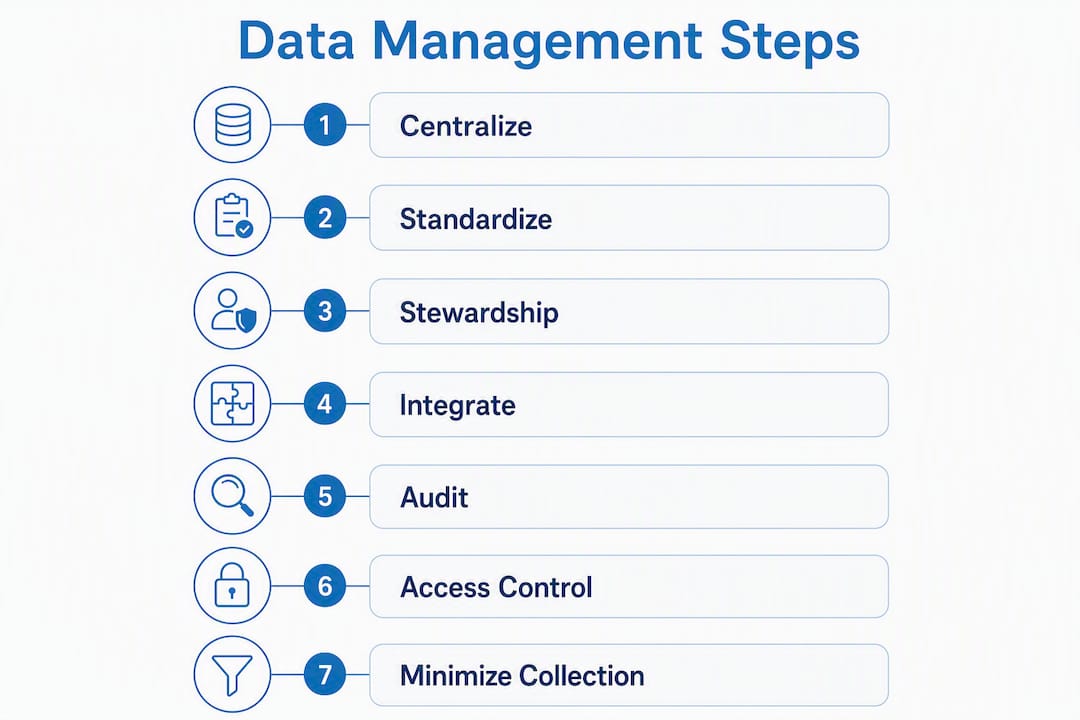
1. Centralize before you analyze. Pick one authoritative source for each data class and route everything through it. This does not mean one giant database; it means one system of record per category, with documented integrations between them.

2. Standardize data entry. Write down the rules: required fields, naming conventions (First Last vs. Last, First), date formats, address standards, and how to handle missing information. Post them where staff actually work.
3. Assign data stewards. Each major data category needs a named owner who is responsible for quality, not just access. Program data belongs to the program director; donor data belongs to the development director. The steward reviews quality monthly and escalates problems.
4. Integrate program and fundraising data. Even a simple, documented process for sharing outcome summaries between program and development teams improves grant narratives and donor communications. A full integration is better, but a documented manual process beats nothing.
5. Embed outcome capture into workflows. If staff have to go back and enter outcomes after the fact, they will not do it consistently. Build outcome fields into intake forms, session logs, and case closure checklists so data is captured at the point of service.
6. Run regular audits. Quarterly audits, plus monthly spot checks for high-caseload programs, prevent the report-day emergencies that consume entire staff weekends. A spot check takes 30 minutes: pull 20 records, check required fields, flag duplicates.
7. Enforce role-based access controls. Not everyone needs to see everything. Finance staff do not need client case notes; program staff do not need full donor giving histories. Limit access to what each role genuinely requires.
8. Minimize collection. Collect only what you will actually use. Every extra field is a maintenance burden, a privacy risk, and a source of incomplete records. If you cannot name the report or decision that field supports, remove it.
9. Train staff regularly. Data quality is a people problem as much as a systems problem. A 30-minute onboarding session on entry rules, plus a brief annual refresher, prevents most of the inconsistencies that make audits painful.
Sample policy items you can adapt immediately:
- Data retention: "Client records are retained for seven years after case closure, then securely deleted per [applicable state law]."
- Required fields: "No donor record may be saved without: First Name, Last Name, Primary Email or Phone, and Gift Date."
- Naming convention: "Organization names use the legal name as it appears on IRS filings, no abbreviations."
- Access levels: "Case notes are accessible only to the assigned case manager and their supervisor."
Pro Tip: Governance does not have to start as a 40-page policy manual. Write a one-page data stewardship statement, assign three stewards, and schedule a monthly 20-minute check-in. Iterate from there. The organizations that build governance as a living practice outperform those that treat it as a one-off compliance exercise.
What software can and cannot do for your data
Software is an enabler, not a solution. The right platform makes good practices easier to maintain; the wrong one, or the right one implemented without process discipline, just automates the mess.
Features to prioritize when evaluating any platform:
- API or ETL integrations with your other core systems
- Role-based permissions with audit logs
- Deduplication tools or merge workflows
- Configurable required fields and validation rules
- Reporting and dashboard exports in standard formats (CSV, PDF, Excel)
- Data export rights (you own your data and can leave)
Software categories and what they do:
- CRM: Manages donor relationships, giving history, and communications. The primary system for development teams.
- Case management: Tracks clients, services, and outcomes. The primary system for direct-service programs.
- Financial system: Manages transactions, fund accounting, and grant expense tracking.
- Analytics/BI tools: Aggregate data from multiple systems for dashboards and trend analysis.
- Integration middleware: Connects systems that do not have native integrations (Zapier, Make, or custom API connectors).
Representative platforms worth investigating:
| Platform | Category | Best Fit |
|---|---|---|
| Salesforce Nonprofit Success Pack (NPSP) | CRM + program tracking | Mid-to-large orgs with technical capacity or a Salesforce admin |
| Bloomerang | Donor CRM | Small-to-mid orgs focused on retention and fundraising |
| Blackbaud (Raiser's Edge NXT, Financial Edge) | CRM + financial | Larger orgs needing integrated fundraising and fund accounting |
| Knack | Low-code database | Orgs building custom program tracking without a developer |
| NeonOne | Donor CRM + events | Orgs combining fundraising, events, and membership management |
Case management systems are the operational foundation for human services nonprofits because they reflect actual program workflows and centralize client data where it is created. If your organization delivers direct services, start your software evaluation there, then ask how the case management platform connects to your CRM.
One more thing worth saying plainly: simple structured analysis often outperforms expensive AI in nonprofit settings. A well-maintained spreadsheet with consistent data can answer most operational questions. Buy the sophisticated tool when you have outgrown the simple one, not before.
Common data management mistakes nonprofits make
Most data problems in nonprofits trace back to a short list of recurring mistakes. Recognizing them is the first step to stopping them.
Spreadsheets as the system of record. A shared Google Sheet is not a database. It has no access controls, no audit log, no deduplication, and no validation. When five people edit it simultaneously, you get five versions of the truth. Fix: migrate the most-used spreadsheet to a proper system within 60 days, starting with donor records or program enrollment.
Over-collection. Intake forms with 40 fields that no one ever queries. Every unused field is a privacy liability and a data quality problem. Fix: audit your intake forms and remove any field that cannot be tied to a specific report or decision.
Unclear ownership. "Everyone is responsible for data quality" means no one is. Fix: assign a named steward for each data category this week, even informally, before any system changes.
Weak or missing access controls. Sensitive client data accessible to every staff member, or donor giving histories visible to program interns. Fix: review permissions in your current systems and restrict access to role-appropriate levels.
Siloed program and fundraising data. Development staff writing grant reports without access to program outcome data, or program staff unaware of grant restrictions that affect their service delivery. Fix: establish a monthly data-sharing meeting between program and development, even before a technical integration exists.
One-off point solutions. Adding a new app for every new program without asking how it connects to existing systems. Fix: require an integration plan before approving any new software purchase.
Skipping audits. Assuming data is clean until a funder asks a question you cannot answer. Fix: schedule a 30-minute monthly spot check now, before the next reporting deadline.
Pro Tip: Two governance rituals prevent most report-day emergencies: a monthly 20-record spot check (any staff member can run it) and a quarterly full audit (data steward-led). Put both on the calendar for the next 12 months before you do anything else.
A 30/60/90-day plan to improve your data operations
This plan is designed for a small-to-mid-size nonprofit with limited technical staff. Adjust the timeline based on your capacity.
Days 1–30: Discovery and quick wins
- Inventory every system where organizational data lives. Include shadow systems (personal spreadsheets, email inboxes used as filing systems).
- Name data stewards for program, fundraising, and finance data.
- Document current entry rules, even if informal. Write down what you actually do, not what you wish you did.
- Run a sample audit: 50 records from your primary donor or client system. Count duplicates, missing required fields, and inconsistent naming.
- Identify one quick win: one integration to enable, one spreadsheet to retire, or one form to simplify.
Days 31–60: Centralization and cleanup
- Migrate or consolidate the highest-priority dataset (usually donor records or active client enrollment) into a single authoritative system.
- Run a more comprehensive cleanup on that dataset: merge duplicates, fill required fields, standardize naming.
- Train all staff who touch that dataset on the new entry rules.
- Begin monthly spot checks. Assign the first one to a data steward.
- Draft a one-page data stewardship statement and share it with leadership for review.
Days 61–90: Governance and reporting
- Implement role-based permissions in your primary systems. Remove access that is not role-appropriate.
- Automate one recurring report (funder report, board dashboard, or monthly giving summary).
- Formalize a data retention policy and get leadership sign-off.
- Present a data quality summary to leadership or your board: duplicate rate, required-field completion rate, and time-to-produce-funder-report before and after cleanup.
- Schedule the next quarterly audit.
Metrics to track from day one:
- Time to produce a standard funder report (target: cut it by half)
- Duplicate rate in your primary system (target: under 2%)
- Percent of records with all required fields completed (target: 95%+)
- Number of unauthorized access incidents (target: zero)
- Staff hours spent on manual reconciliation per month (track the trend)
Operational efficiency in this context means maximizing mission-driven outcomes with existing resources, not just cutting costs. That framing matters when you present this plan to a board or funder: you are not asking for money to fix a mess; you are investing in the capacity to demonstrate impact.
Ethical data stewardship and governance standards your nonprofit should know
Data governance in the nonprofit sector has moved beyond password policies and locked filing cabinets. Two frameworks are shaping what funders, partners, and communities now expect.
Better Deal for Data (BD4D)
The BD4D Standard and Playbook reframe data as a trust-based responsibility. The core argument is that nonprofits handling community data should be able to articulate, in plain language, how they collect it, why they keep it, who can see it, and how it benefits the people it describes. BD4D commitments include:
- Collecting only what is necessary for a stated purpose
- Giving clients meaningful control over their own records
- Sharing data with partners only under documented agreements
- Publishing a stewardship commitment that communities can hold you to
The BD4D Playbook provides concrete implementation resources, including consent checklists and data-sharing agreement templates, that organizations can adapt without a legal team.
CAN/DGSI 100-11:2025
The CAN/DGSI 100-11:2025 standard is a sector-specific, equity-driven governance roadmap developed in collaboration with nonprofits, funders, and human services organizations. Its practical elements include:
- Data minimization requirements (collect only what you need)
- Anonymization protocols for shared or published data
- Consent and access control specifications for sensitive client records
- Equity considerations for how data collection affects marginalized communities
Even if your organization is U.S.-based and the standard originated in Canada, its framework maps directly onto the governance gaps most American nonprofits face. Funders and accreditation bodies are increasingly referencing similar principles.
"Data stewardship is not just a compliance obligation — it is how organizations demonstrate that they are trustworthy partners to the communities they serve. Publishing a clear stewardship commitment builds donor confidence, eases data-sharing with partner agencies, and reduces the risk of a privacy incident that could damage years of community trust." — BD4D framework guidance
Pro Tip: Map your organization's current practices against the BD4D commitments in a single afternoon. For each commitment, mark it as "done," "partial," or "not started." That one-page gap analysis becomes your governance roadmap and a credible artifact to share with funders who ask about data practices.
Key Takeaways
Effective nonprofit data management starts with centralization and named ownership, not software, and organizations that treat it as a leadership priority rather than an IT task reduce planning timelines and produce cleaner funder reports faster.
| Point | Details |
|---|---|
| Centralize first, then analyze | Pick one authoritative system per data category before evaluating new tools or running analysis. |
| Name data stewards | Assign a named owner for program, fundraising, and finance data this week, even informally. |
| Audit on a schedule | Monthly spot checks and quarterly full audits prevent most report-day emergencies. |
| Integrate program and fundraising data | Connecting outcome data to donor records improves grant narratives and funder confidence. |
| Nonprofitconsultingswfl | Provides diagnostic audits, governance setup, and 30/60/90 implementation support for Florida nonprofits. |
A consultant's perspective on what actually moves the needle
Most nonprofit data problems are not technology problems. They are ownership problems.
When a team comes to me with a "data crisis," the presenting issue is usually a funder report due in three days that requires data from four systems no one has reconciled in six months. The real issue, almost always, is that no one was ever explicitly responsible for keeping those systems aligned. The data steward role did not exist, or it existed on paper and no one had time for it.
The organizations that fix this sustainably do not start by buying a new CRM. They start by drawing a map: what data do we have, where does it live, who owns it, and what decisions does it need to support? That diagnostic, done honestly, usually reveals that the existing tools are adequate. The problem is process, not platform.
What I have seen work in Florida nonprofits, from small community organizations to mid-size human services agencies, is a light governance structure stood up quickly: three named stewards, a one-page entry rules document, and a monthly 20-minute check-in. That structure, maintained consistently, prevents the crisis cleanups that consume entire staff weeks before major grant reports.
The 30/60/90 plan in this guide reflects that approach. Start with discovery, not decisions. Name owners before buying tools. Clean one dataset thoroughly before expanding to others. And treat the first funder report produced from clean, integrated data as the proof point that earns leadership buy-in for the next phase.
Data governance is not a destination. It is a practice, and the organizations that build it into their operating rhythm stop dreading reporting season.
Nonprofitconsultingswfl can help you get your data under control
Florida nonprofits dealing with fragmented data, report-day scrambles, or grant compliance gaps have a faster path forward than rebuilding systems from scratch.
Nonprofitconsultingswfl works directly with nonprofit leaders to run the diagnostic audit that most organizations skip: mapping every data system, identifying ownership gaps, and building a realistic 30/60/90 plan tailored to your programs and funders. Services include strategic planning, grant writing support, capacity building, and hands-on data governance implementation. If your team spends more time reconciling spreadsheets than delivering programs, or if your last funder report took three times longer than it should have, that is the signal to bring in outside expertise.
What an engagement looks like: a structured discovery session, a written gap analysis, a prioritized action plan, staff training on entry rules and stewardship practices, and follow-through support as you implement. No long-term retainer required to get started.
Contact Nonprofitconsultingswfl to schedule a discovery conversation and find out what a cleaner data operation could mean for your next grant cycle.
Useful sources and further reading
The resources below are the primary references used in this guide. Each one offers practical material you can use immediately.
| Resource | What It Offers |
|---|---|
| Better Deal for Data (BD4D) | Stewardship framework, commitment language, and consent checklist templates for nonprofits |
| BD4D Playbook — TechMatters | Implementation resources including data-sharing agreement templates and governance tools |
| CAN/DGSI 100-11:2025 Standard | Sector-specific governance standard covering minimization, consent, access controls, and equity |
| Nonprofit Data Management Best Practices — LiveImpact | Practical tactics for centralizing data, assigning stewards, and running audits |
| Operational Efficiency in NGOs — HelloAuditor | Framing operational efficiency as mission capacity, not cost-cutting; useful for board presentations |
| The Operational Gap — Smartsheet | Case analysis showing how operational discipline reduces planning timelines |
| Operational Efficiency as the Missing Link — HedgeThink | Argument for why fixing data workflows is necessary for fundraising and impact reporting |
| Simple Forecasting Models in Nonprofits — Springer | Empirical study showing structured simple analysis reduces operational waste |
| Nonprofit Data Management: A Stage Model — UNLV | Academic framework for understanding data maturity stages in nonprofit organizations |
Where to start: If you are new to governance, download the BD4D Playbook first. It is the most immediately usable resource in this list, with templates you can adapt in a single afternoon. If your organization serves vulnerable populations and handles sensitive client data, read the CAN/DGSI 100-11:2025 standard summary next. The UNLV stage model is worth reading if you want a research-grounded framework for assessing your organization's current data maturity and planning a realistic progression.